TOSS

Recently, we uncovered a virtual midden, a repository of debris tied to the insatiable greed of resource extraction. From this chaotic pile of scandal and exploitation, we propose an excavation. 

These artefacts are alluring, their superficial appeal catching the eye as they glisten within the sediment of the past. They speak volumes about humanity’s behaviour—our insatiable desire to exploit, extract, consume, and discard. Through this exhibition, we will reflect on these patterns of destruction and the undeniable truths they leave behind. 

MIDDEN collective are Sarah Edmondson, Mary Martin and Niamh McGuinne – who together focus on the interpretation of evidence, creating decidedly unscientific work combining fact with fiction to create new narratives.

The objects that caught my eye included: a pile of crumbling mica, some silver scales and a heap of seaweed, glistening in the low tide. The theme of this collection of works addresses ideas of waste, over-exploitation and greed. Individually they appear disparate but on closer inspection there are links and connections binding them together.

Mica refers to a group of 37 naturally occurring silicate minerals which are mainly used in electronics, construction, cosmetics and car manufacturing due to their heat resistence, insulating and reflective properties. It is used in the plastics industry as it is so lightweight and has sound absorption properties. It is a familiar additive in pearlescent paints, coatings and cosmetics. It improves corrosion resistance and durability of industrial components and equipment. Its ability to withstand electric currents makes it useful in electronic transformers, semiconductors and circuit boards in addition to household items such as heaters and his dryers. It is added to lubricants and in the car industry it can be found in brake linings, rubber components, and is increasingly useful in electrical battery packs and electric vehicles. Most mica is mined and extracted from India and Madagascar, followed by Brazil, USA, Malaysia and its mining is spreading throughout the African continent due to the increase in demand. It is commonly associated with poor communities lacking education and healthcare, unregulated conditions and child labour and illegal mining with workers only earning a tiny percentage of its worth – well below a living wage.

In Reliquary, I am looking at the local mica housing crisis, where in an effort to save money, mica was added to the concrete aggregate in the form of an extender. It was unregulated and under-researched – its propensity to absorb water caused damage in freeze thaw cycles leading to widespread destruction. The defective concrete has been described as crumbling and Weetabix-like in texture.

A reliquary is a vessel created to protect something sacred – and as is custom, it is an object of great value both materially and conceptually. This reliquary holds the memory of this failing at the hands of an insatiable greed for resource extraction, a decision to cut corners in the process (to increase the profit margin) – and an example of unethical extraction compounded by questionable source locations and labour practices. This memory has a value. 

These artefacts are alluring, their superficial appeal catching the eye as they glisten within the sediment of the past. They speak volumes about humanity’s behaviour—our insatiable desire to exploit, extract, consume, and discard. 

In Nite Klub Parasite, all that was left of a vibrant club scene are a few silver scales, vestiges of a disco ball perhaps or something more sinister. Ireland’s nightclub industry continues to face a major decline, with only 83 clubs still operating nationwide, down 83% since 2000. Many of these clubs are now boutique hotels and suppliers of fine goods. Campaign group Give Us The Night highlight exorbitant costs, strict licensing laws, and early closing times as contributing factors. Dublin’s 2:30 AM closing time is the earliest in the EU with 6:30 AM the average in other capital cities and the Special Exemption Order (SEO) required to operate costs €21,320, plus legal fees, per year.

Smaller clubs and regional venues are less able to absorb these legal fees, staffing costs, insurance, and rising energy bills. There has been a suggestion to freeze VAT on dance/music events, to relaunch the 2023 Noise Mitigation Grant Scheme and to increase early Sunday morning bus availability and bike parking. 

In the meantime, these restrictions are acting like a parasite on the sector, slowly draining the life from Ireland’s nightlife economy. Piecing the scales together with artistic licence, I have reconstructed a larger than life imaginary parasite that in the form of rising rents, insurance, and overheads, slowly sucked the life out of the sector.

Through this exhibition, we will reflect on these patterns of destruction and the undeniable truths they leave behind. Arramara Teoranta, owned by Canadian multinational Acadian Seaplants, has renewed applications for large-scale seaweed harvesting rights along parts of the Galway coast. Now compared to oil or gold, seaweed is considered valuable for pharmaceuticals, cosmetics, animal feed and other industries. Particularly important are species like kelp and ascophyllum nodosum (feamainn bhuí), which are used in alginate extraction and agricultural products. The controversy is about ownership, environmental impact, and whether Gaeltacht communities should keep control over marine resources that have supported them for generations. Bounty reminds us of the value that should be placed on the natural resource, rather than the financial sell-out for short term gain. The fact that this proposal continues to surface shows a belief that a community can be worn down by wealthy global entities supported by the indifference and greed from particularly non-local government agencies that encourages their campaign.

A collaborative piece There’s Millions in it, references often misquoted (There’s Gold in them that hills) Mark Twain’s 1892 ‘The American Claimant’. The hills in this case are Tyrone’s Sperrin Mountains, where Canadian company Dalradian Gold wants to mine in a designated Area of Outstanding Natural Beauty. The mining firm has been working on the Curraghinalt site near Greencastle since 2009 and has applied to develop an underground gold mine. The public inquiry is ongoing, this being the third time a hearing has been convened.

Dream House

Desiccated hydrogel and mica flakes, 120 x 55 x 55cm. 

This piece references the Mica Housing scandal and how dreams that are built to last can be easily eroded. As has been documented, mica was used as a bulking agent in concrete and its unintended disintegration has led to tragic and disastrous effect. In Dream House, the mica produces a shimmering unreal surface and entry is impossible. The house is made from a mixture of edible gels which are adapted for use in paper conservation, here they have been loaded with mica and desiccated to create a rigid structure. However, if exposed to the elements it will invariable turn to a pile of mush, a bit like the magic pumpkin in Cinderella.

Model Homes

Encaustic on printed panel, 40 x 30cm.

The use of hydrogel + mica as a material is a familiar combination in the cosmetic industry to promote youthful hydration and a healthy shimmer in beauty products. Naturally, it is both temporary and surface deep and designed to disintegrate or require ongoing maintenance. In Model Homes, the house has been replaced by body forms to emphasise fragility, a fragility associated with the temporality of beauty ideals and the effects of time on the body’s shell.

In Your Place

Screenshot

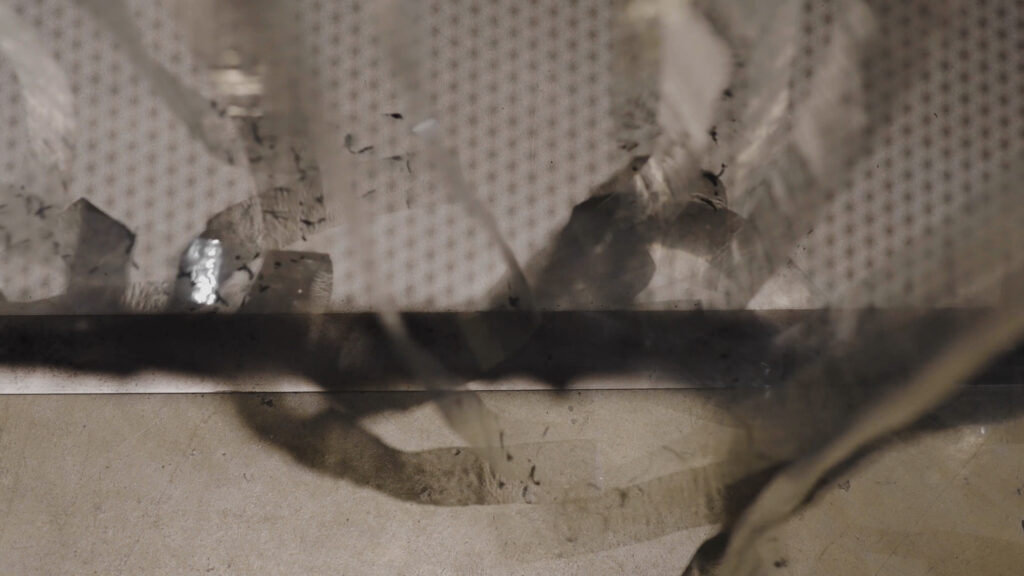
04:30 transferred super 8 and digital video.

Inspired by the recent referendum on Article 41.2 of the Constitution which proposed to replace specific references to women with gender neutral wording, ‘In Your Place’ highlights the ongoing reality of women’s position as the principal caregivers and unpaid workers in the home. The short film presents a claustrophobic situation and suffocating figure without a means to communicate.

An Impossible (T)ask

Desiccated hydrogel and mica flakes, 110 x 65 x 40cm.

This piece references the feats of endurance or the antidotes to sorcery found in tales such as the Wild Swans and the Children of Lir where the protagonist is tasked with an arduous test of faith or physical exercise designed to counteract the evil spell of the usually wicked stepmother (who is trying herself to eek out an existence in a patriarchal environment). In this instance it is the societal expectation of combining the mother/provider/career professional/carer and idealised woman that is the impossible task and ask. Like a shed skin, the incomplete dress has been discarded, its occupant hopefully liberated…

A Tenuous Line

Custom House Studios + Gallery

Thursday 5 March – Saturday 11 April 2026

Middens are accumulations of discarded material, historical rubbish heaps. Those situated along coastlines typically contain shells, bones and other such remnants of survival. They are found in Ireland and across the world and are read as sites of temporary occupation, holding traces of movement, diets, temporary settlements and lives shaped by nomadic patterns; evidence of the practice of economic migration that persisted well into modern history. While research has largely focused on the Mesolithic period (8000 – 4000BC), the Irish coastline holds midden sites spanning from pre-farming societies to early Christian times. There are 77 recorded midden sites in Mayo, eighteen of which are sheltered in Clew Bay. 

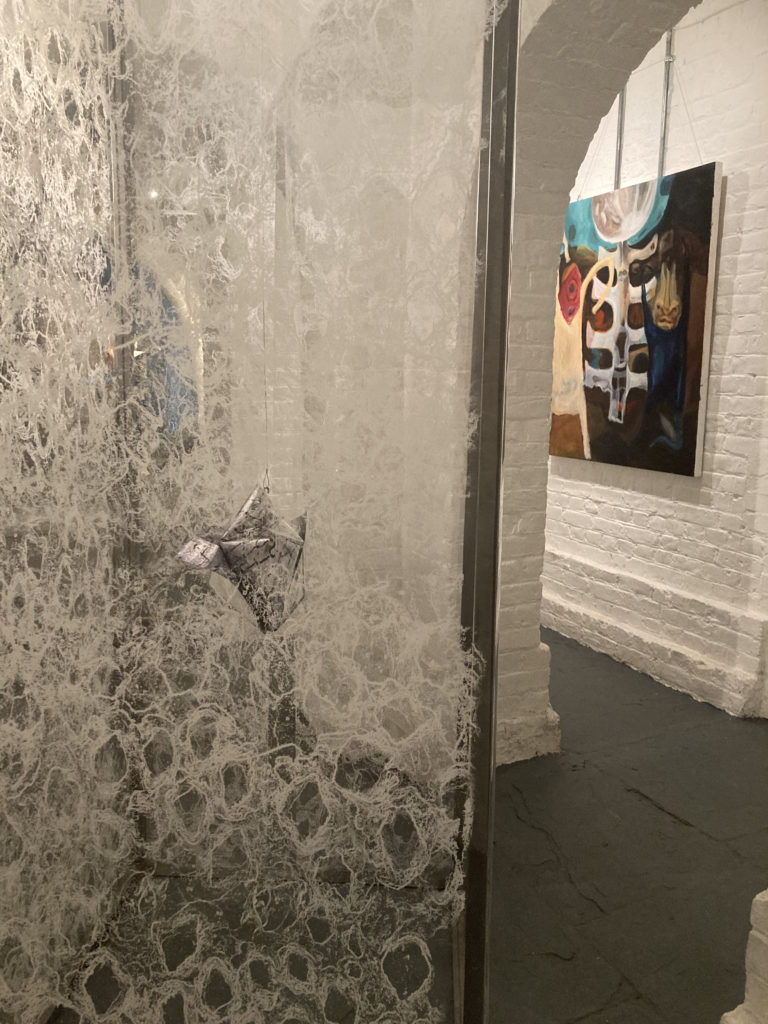
In response, A Tenuous Line, uses the form of a folding screen to represent this cradling landscape. A screen functions as a portable threshold in terms of physical protection or when employed as a verb, screening can expose and be used to selectively exclude. From one side it offers expansion; from the other, containment. A thin structure that decides what passes and what does not. The screen employs a motif associated with commercial shop grilles; a boundary that sits uneasily between categories: it is not a net for gathering, a mesh for protection, nor bars for incarceration. Its scalloped pattern evokes shells or scales, natural forms of protection grown by necessity, yet its familiar commercial use ultimately signals restriction. Shells are associated with protection but they also restrain, this contradiction, how the structures that make us feel safe can also trap us, is central to my practice.

The shells incorporated into the work were once valuable commodities, sources of nourishment and possibly of ritual or decorative significance. By placing them behind the scalloped grille, I reframe them as objects of value, drawing attention to the shifting systems through which worth is assigned and preserved. The grille exists to safeguard assets; protection hardens into denial, it is an economic barrier. This tenuous line is not a line drawn on a map. It is a line drawn around resources, around bodies, around access. Viewers are invited to engage on both a personal and universal level, encountering their own vulnerabilities and memories within the structure, questioning what it means to seek protection while remaining exposed.

The Ties that Bind

‘The Ties that Bind’ is S/TAC’s fourth show to date and focuses on emotional, somatic and psychological aspects of shelter, presenting a short film The Ties that Bind, the collaborative installation The Clothesline, and a selection of works on paper to illustrate the genesis of the project which was initiated through a collaborative workshop held in the Chocolate Factory, Dublin 1.

‘The Ties that Bind’ is a short film created for Waterford’s Imagine festival for GOMA and was filmed and edited by Fillipe Lezo with S/TAC. The clothesline can signify a variety of feminist and feminised ideas and is a deep-reaching metaphor for the ties that bind families, communities and women together. Strung together it becomes a symbol of the chaos and intersection of lives and cultures within an imposed vertical grid. The lines can be seen to embody twin notions of shelter/ exposure; concealment/revelation; reality/fiction; conscious/unconscious.

The Clothesline installation comprises a number of painted and printed textile pieces, each depicting a particular source of imagery, approach and palette associated with the members of the collective as individuals. While each carries the distinctive marks and gestures of each of the five artists of S/TAC, the whole work is unified through over-printing using colour and stencilled motifs which reference a connecting theme of exposure and masking of internal body organs. The collaborative installation acts as a symbol of shelter, connectedness and intersection which overtly plays with notions of ‘life on view’, private versus public, acts of display and exposure, domesticity and ‘women’s work’…

The works on paper were developed and facilitated by an Arts Council funded workshop, which focussed on the embodiment of experience. Using mono-print and stencilling the first stage of the process which led to The Clothesline and has culminated in the film ‘The Ties that Bind’, saw an extended collaborative group including the collective, curators, scientists and individual artists create collage and layered prints on paper. These small prints were originally formed into giant capes and worn before being finally dismantled and sewn into books. In 2023, when the group was invited to exhibit in the National Gallery of Ireland, this work was further developed into The Clothesline using the concepts and processes initiated in the collaborative workshops.

Accompanying these collaborative works are a selection of pieces by each of the artists which provide some hints and suggestion to the particular significance/resonance to each and how that feeds into and is nourished by the participation and collaboration of a collective.

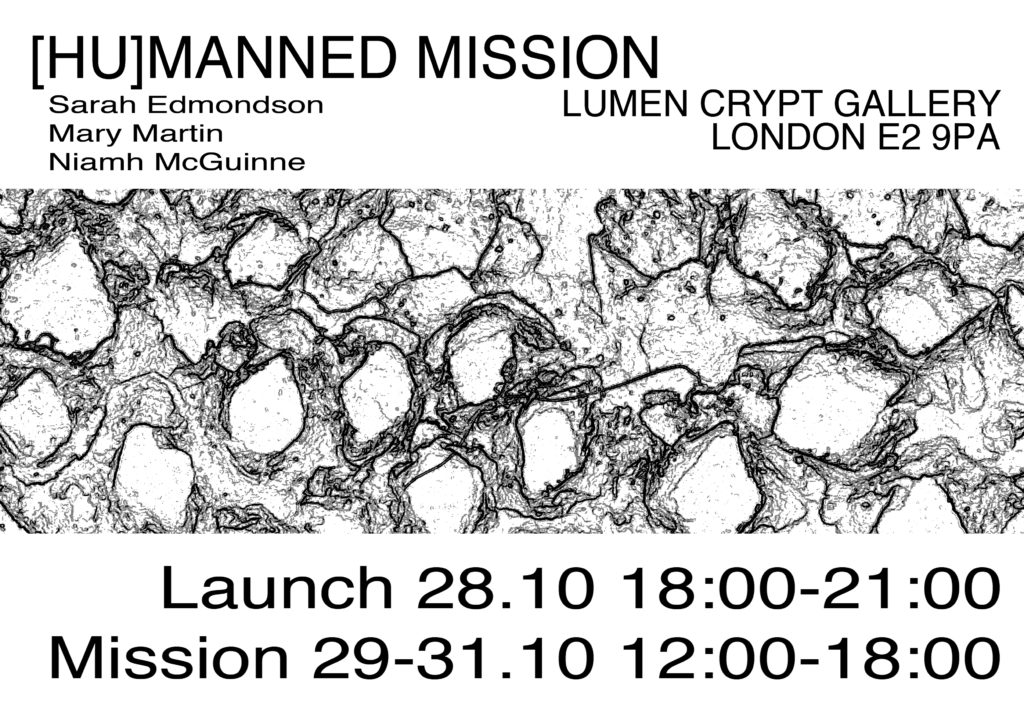
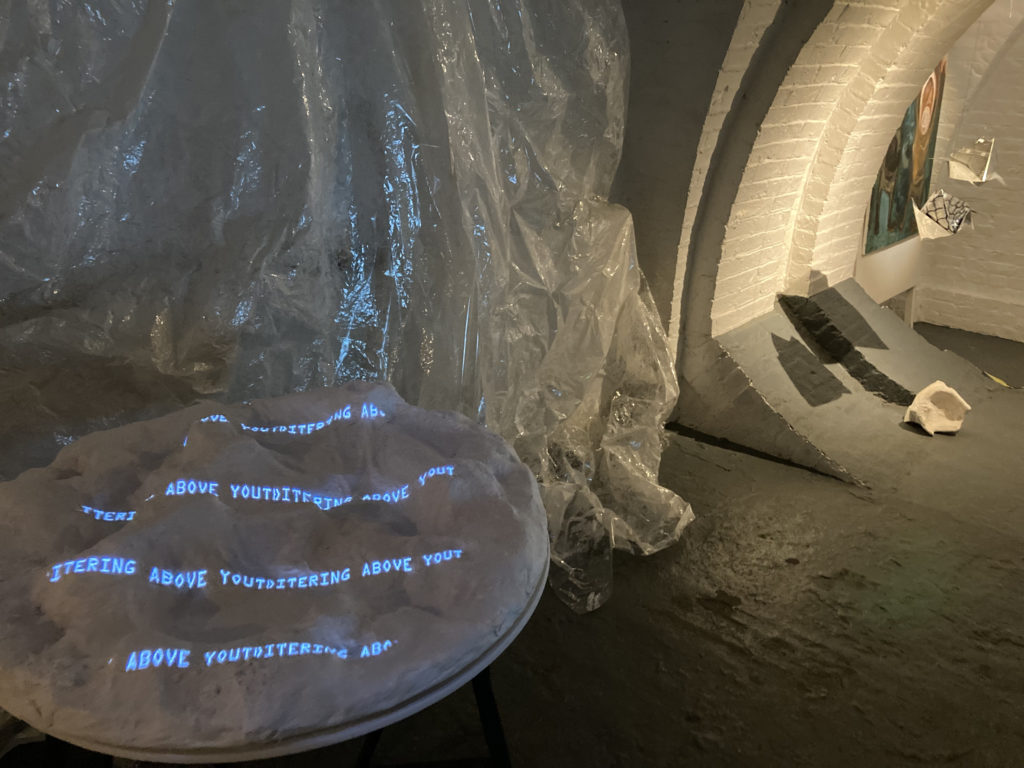
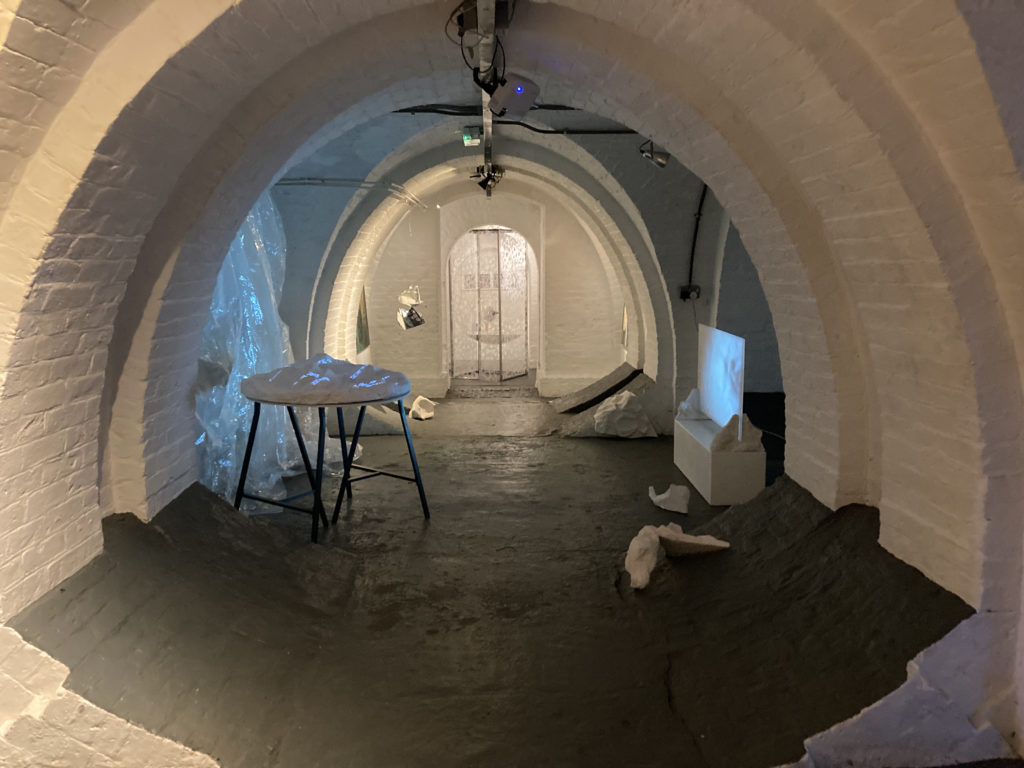
[Hu]Manned Mission

[Hu]Manned Mission is a pseudoscientific exploration into humans’ interactions with the moon. An appraisal of lunar myths and missions, combining fact with fiction to create new narratives. It offers an invitation to reconnect and communicate with your moon, to consider the importance of language in your quest, because … it matters what stories we tell to tell other stories with; it matters what knots knot knots, what thoughts think thoughts, what descriptions describe descriptions, what ties tie ties. It matters what stories make worlds, what worlds make stories (Haraway, 2016).

The moon is a distant object, gazed upon by more humans than any other solid object in the universe (Morton, 2019), yet its surface has only been walked on by 12 white American men. The only people to have experienced it first-hand. However, does that make the rest of our knowledge less valid?